In practically any review of great camping gadgets you will see a variety of methods to generate electricity from the sun, hand cranks and…. Your CampStove.
Now to many campers the very idea of generating electricity to power your other mobile gadgets like phones and tablets completely defeats the reasons for going camping. For many of us the ability to charge our phones or GPS devices is essential.
The obvious advantage of getting power from your campfire is you don’t need to expose a panel to the sun for long periods. It can be a whole lot easier than turning a hand crank generator for 20 mints too.
The question is…
Are stove power supplies any good?
A skeptic’s review of the BioLite CampStove: it’s neat but mostly impractical
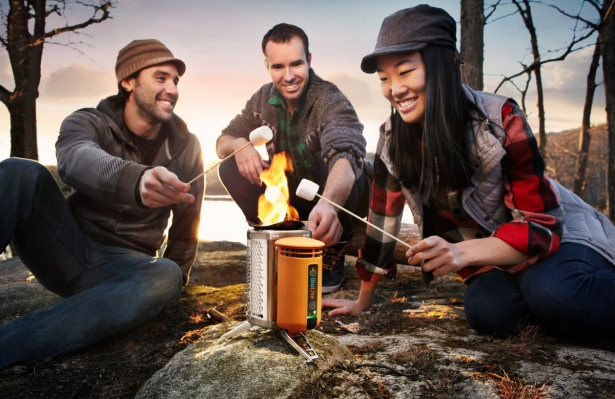
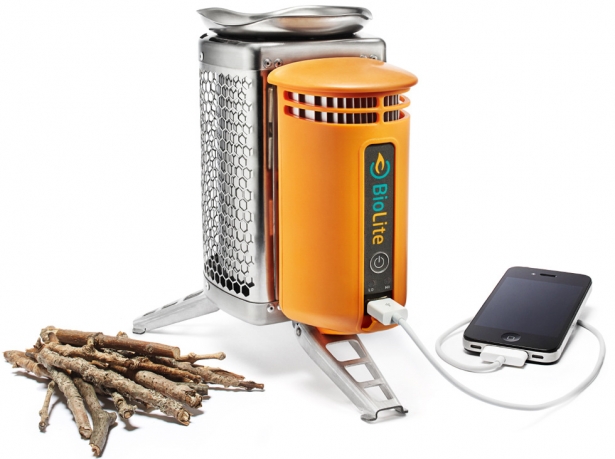
A major attention-grabber at last week’s Outdoor Retailer Summer Market (ORSM) was the BioLite CampStove, a unique biomass-burning stove that will boil water and charge your electronics via USB. The CampStove was featured by many of the most popular online media outlets, including Outside, GearJunkie, and TrailSpace; Brian Green has also written about it a few times.
I have not seen or used this stove myself, so perhaps I’m missing something, but I’ve been surprised by the excitement over this product. Frankly, I’m a skeptic. Based on my extensive experience with common backpacking stoves (e.g. liquid fuel, gas canister, alcohol, and esbit), with other wood stoves (namely the revered Bushbuddy), and with cook fires, I’m doubtful that the CookStove’s popularity as a backcountry stove will be long-lasting. Two simple reasons:
1. It’s really heavy.
The stove weighs 33 oz, not including a pot or fire-starting supplies; assume that a complete CampStove system will weigh about 40 oz, or 2.5 pounds. Its weight is very difficult to justify for a backpacking trip that entails even a moderate amount of hiking, as pack weight then needs to be an important consideration.
“But I can heat up an infinite amount of water.” Yes, you can. But in all but the most extreme applications (e.g. you are living off the land for months) there are lighter and more user-friendly options. For example, my preferred Fancy Feast alcohol stove system weighs about 6 oz, making it 34 oz lighter. If I carried 34 oz of fuel on a trip, I’d have enough fuel for about 45 meals. Even if I was hiking with a large group, which by nature will consume a lot of fuel, I would still choose a more efficient system than the CampStove: I would break the group into small cook groups and give each cook group a stove (probably alcohol or canister).
“But I can recharge my electronics infinitely.” Yes, again, you can. But personally I’d rather take extra batteries, which won’t require me to stop hiking and to build a fire so that they can be recharged — I go backpacking to hike, not to recharge electrical batteries. Even if I carried a heavy stove like the JetBoil PCS (15 oz sans fuel canister), I could carry a dedicated GPS and a dedicated camera (instead of using an iPhone for these purposes), and a backup headlamp, and maybe extra batteries, without exceeding the CampStove’s 40-oz system weight.
Moreover, if you plan to use the BioLite to recharge your devices, I hope you have are planning ample down-time — it took Philip Werner of SectionHiker two hours of burning wood to bring an empty Android smartphone to 50% power.
2. Cook fires and wood stoves are inherently not user-friendly.
Humans have relied on biomass fires much longer than they have relied on modern backpacking stoves — the skills needed to build a fire are well known. Yet most backpackers prefer non-biomass stoves. Why? Because they are:
- More reliable — Wet wood or no wood? No problem!
- Cleaner — No soot-covered pots and hands, and no ashes in your food
- More time efficient — No need to gather wood, build a tepee, and then tend to the fire
- Foolproof — Suppose you’re a first-time backpacker. Would you rather carry a stove that requires you to build a fire, or a stove that operates like your backyard propane grill?
Moreover, most land mangers prefer — or even mandate — backcountry stoves too, since the frequent burning of biomass in high-use backcountry areas depletes this important resource. There are already enough campsites where people have burned every nearby combustible material, making the area look as if it’s been vacuumed. Open fires and wood stoves are also prohibited in many areas during peak the wildfire months.
Ultimately, I think that wood stoves are romantic but mostly impractical. It’s telling that when I take my Bushbuddy on a guided trip for demonstration purposes, the clients are interested to see how it works but not sold on it enough that they want to trade their alcohol stove with me on Night 2. While the CampStove has an added feature that the Bushbuddy lacks — the ability to recharge electrical devices — presumably it shares the same pitfalls of this stove category.

2 Responses
JP
I use the biolite, have for a few seasons now. I have the kettle pot for it. Together they are the same weight as a msr pocket rocket with fuel can and trail light duo cookset. Time consuming is my only issue. Sometimes when you get to camp you just don’t feel like gathering wood. But overall I am quite happy with it. It takes a while to put a serious charge on anything but a little extra juice on anything is always a bonus.
campingsage
Thanks JP. It’s always good to hear from someone with first hand experience. It is a bit of a monster unit though.