Ten Steps to Getting Started With Ultralight Backpacking
I must confess that I am not an ultralight backpacker/camper. I had my share of carrying my home on my back while in the military many years ago. Nowadays I prefer to have a base on a campsite with all basics provided from which I can manage my excursions.
For some reason, in recent months I have started to contemplate backpacking again. It may be linked to a semi-plan to take up Thru-Hiking on one or 2 of our less demanding trails.
In looking around the internet for some pointers on getting started with ultralight camping/hiking I came across this article from Camile Barile over on backcountry.com. It is quite probably the best, least biassed article on ultralight backpacking I have ever read.
Please note, in copying the article to this site all links within the article have been preserved.
Take a look at the article below and let me know what you think.
Tips for Lightening Your Backpacking Load
On your next backpacking trip, why would you choose to lumber along like a weighed-down pack mule when you could spring up the trail with the agility of a mountain lion? When it comes to hefting a backpack during multi-day treks over rugged terrain, cutting total weight to below 20 pounds for weekend excursions and below 30 pounds for anything longer brings a slew of benefits. A lightweight or ultralight load means fewer blisters, aches, and pains, and makes it possible to hike in lightweight trail running shoes rather than heavier hiking boots (a pound added to the foot is equivalent to five added to your pack). You’ll be able to explore more freely, and cover more miles more quickly.
So, how exactly do you lighten your load? The most impactful way is to start with the basic, essential items that, for the most part, you can’t go without: your backpack itself, your shelter, and your sleeping system. Taking it one step further, you can re-think what your ‘essential’ items are. The key is to balance comfort in camp with comfort on the trail; you just might find that it’s possible to be comfortable in camp with less.
Choose Your Backpack Wisely
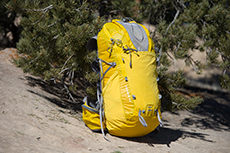
As a general rule, if you’re aiming to shave pounds off your load, scaling down on the weight and size of your backpack is the first place to start. In general, you shouldn’t have a backpack that adds more than 3-4 pounds to your load. Savings can be achieved both by reducing the size of your pack and also by choosing a pack with lightweight construction (lighter materials, fewer pockets and zippers, etc.). If you’re carrying less than 15-20 pounds, consider a frameless backpack, and you’ll be able to drop your backpack weight to under two pounds. But weight isn’t the only factor in choosing a backpack. Frame backpacks help distribute your load weight to take pressure off your shoulders, often feature wider, more comfortable straps than ultralight frameless backpacks, and many include enhanced ventilation features. Some people also find a larger pack to be less cumbersome and better balanced than a smaller pack with an overloaded main compartment and stuff strapped all around the outside.
That being said, some ultralight backpackers prefer going with a smaller frameless pack to force them to leave non-essentials at home and keep weight down. Then, they use techniques like shifting their backpacks from shoulder to shoulder for better ventilation and comfort or carry loads light enough (under 15 pounds) that the thinner straps aren’t a problem.
Go For an Ultralight Shelter
Once you have to carry your shelter on your back, especially for days on end, your definition of “shelter” can change dramatically, and going minimal has many advantages. If the weather’s dry, temperatures are warm to hot, and bugs aren’t an issue, you can easily do without any shelter at all. Simply string up a hammock, or spread your sleeping bag out right in the open. If you prefer a little more privacy or shelter from the sun or elements, a lightweight tarp does the trick. If bugs are an issue, set up a mesh shelter underneath the tarp that uses your hiking poles (rather than a separate set of poles) to hold it up.
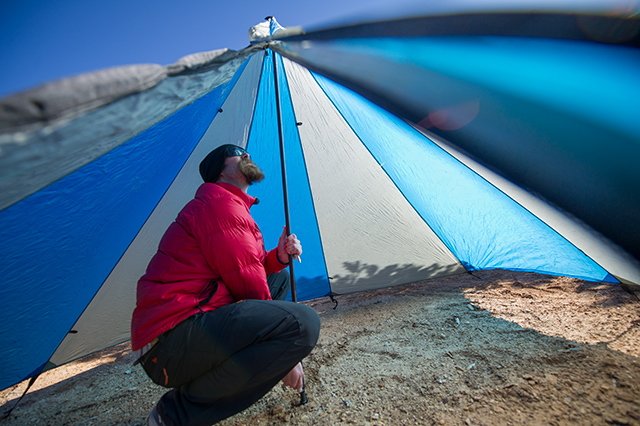
Backcountry.com employee Jason Whitehouse sets up the Black Diamond Mega Light 4-Person Shelter.
With plenty of tents now weighing in at less than three pounds, an ultralight tent is another viable option. Ultralight tents will be slightly heavier and certainly more expensive than minimalist options, but they offer the most privacy and protection, particularly in cold weather. If you do opt for a tent, leave the footprint at home–it’s not essential, and you’ll save additional weight. If it looks like the weather’s going to be good, you can also leave the rain fly behind.
If you’re on a multi-day climbing route where you may be sleeping in tight quarters on an overhang, or you prefer minimal fuss with your camp setup during shorter trips, a bivy sack is another lightweight shelter option. Bivy designs range from minimalist sacks weighing in at less than a pound, to less claustrophobic mini-tent-style shelters.
Sleep in a Down Sleeping Bag
Birds rely on down to keep them warm in the wild, and so should you. Pound for pound, it’s the warmest insulation choice, the most compressible, and the most durable. If you fork out some extra cash in only one area, pay the extra dollars to get a down sleeping bag with a high (more than 700) fill count. One drawback of down is its ability to insulate when wet. Most down sleeping bags feature water-repellent coatings on the outer fabric, and a number of companies are treating the down itself so it repels water, enabling it to continue insulating even in wet circumstances. Using a down bag instead of a synthetic bag can save you nearly a pound of weight, its compressibility allows you to stuff it into a small corner of your backpack, and its ability to loft back up over and over again ensures, with proper care, that it stays fluffy and warm throughout years of backpacking trips.
The Great Sleeping Pad Debate
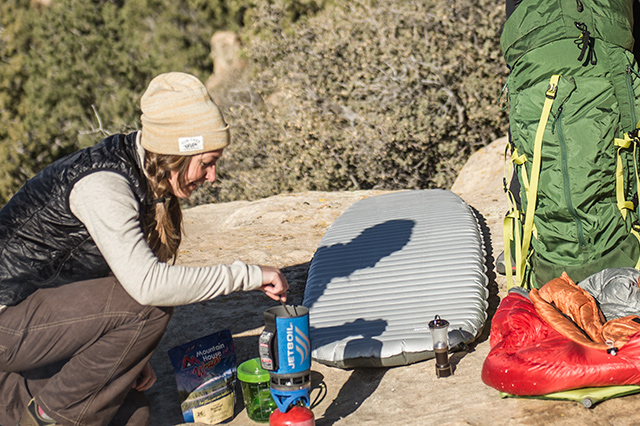
The Therm-a-Rest Neo Air XTherm Sleeping Pad, shown above, is a a lightweight and insulated option for those looking for a bit of cold weather protection.
Your choice of sleeping pad and whether or not you even bring one at all can be a highly personal choice. Options abound, ranging from foam to air mattresses in varying lengths and sizes. There are some great cushy, yet very lightweight, air mattresses like the Exped SynMat UL that weigh under a pound and include some integrated insulation to resolve the problem air mattresses have had with providing adequate warmth. Or, if you’d prefer to not risk a puncture deflating your pad, ultralight, closed-cell foam pads like the Therm-a-Rest Z Lite Sleeping Pad or Therm-a-Rest Z Lite SOL (insulating) Sleeping Pad offer cushioning while adding less than a pound to your load. 3/4-length pads are another option. You can prop your legs up over your backpack to elevate them while you sleep (great for recovery), and less pad means less weight to carry.
Read the rest of the article over at Backcountry.com

Leave a Reply